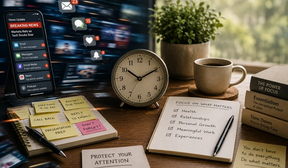

The Hidden Cost of Optimizing Everything
Emely Pitts
July 25, 2026
Modern life is full of advice on how to become more efficient. We can optimize our morning routines, workouts, finances, diets, productivity systems, and even our hobbies. Every day seems to bring a new app, framework, or strategy promising to help us do more in less time.
While optimization has undeniable benefits, constantly trying to maximize every minute can come at a cost. When every activity becomes something to improve, measure, or perfect, it’s easy to lose sight of why we were doing it in the first place.
Efficiency isn’t the same as fulfillment
Being efficient helps us complete tasks more quickly, but not every part of life should be measured by speed or productivity.
A conversation with a friend, a family dinner, or an afternoon spent reading doesn’t need to produce a measurable outcome to be worthwhile. Some experiences are valuable simply because they allow us to connect, reflect, or enjoy the present moment.
Not everything meaningful can be tracked or optimized.
Sometimes the greatest value comes from experiences with no obvious return.
Constant optimization can become exhausting
Trying to improve every aspect of life creates its own kind of pressure.
Instead of feeling satisfied with progress, it’s easy to become focused on finding the next habit, the next productivity system, or the next way to save a few more minutes. This mindset can make it difficult to appreciate how far you’ve already come.
Improvement is valuable, but it shouldn’t become a never-ending source of stress.
There is a difference between striving for better and never feeling good enough.
Creativity needs room to wander
Many great ideas don’t appear during tightly scheduled, highly optimized moments.
They emerge while taking a walk, daydreaming, chatting with friends, or exploring something without a specific goal. Unstructured time allows the mind to make unexpected connections that constant busyness often prevents.
Creativity benefits from curiosity, not just efficiency.
Leaving space in your schedule can be surprisingly productive.
Relationships don’t follow productivity metrics
Strong relationships grow through shared experiences, patience, and attention.
You can’t rush trust, schedule meaningful conversations down to the minute, or measure the value of spending time with loved ones using productivity tools. Some of life’s most important moments happen spontaneously.
The quality of your relationships depends more on presence than efficiency.
People remember how you made them feel, not how well you managed your calendar.
Rest has its own purpose
It’s tempting to treat rest as something that exists only to make us more productive later.
But relaxation, hobbies, and quiet moments have value beyond improving work performance. They help reduce stress, strengthen mental well-being, and remind us that life isn’t only about achieving goals.
Rest isn’t something you need to justify.
It’s an essential part of living well.
Focus on what truly deserves optimization
This doesn’t mean optimization is a bad thing.
Improving financial habits, simplifying repetitive tasks, or organizing your workspace can free up valuable time and energy. The key is deciding where efficiency creates more freedom and where it begins to reduce joy.
Optimize the routines that support your life, not the moments that give it meaning.
The goal is to make space for what matters, not to turn every experience into a performance metric.
Optimization can be a powerful tool when it’s used thoughtfully, but it shouldn’t become the purpose of life. Some things deserve to be efficient, while others deserve to be slow, imperfect, and fully experienced. By choosing carefully where to pursue efficiency, we can enjoy the benefits of modern productivity without sacrificing creativity, relationships, or peace of mind. In the end, a meaningful life isn’t measured by how perfectly it’s optimized, but by how fully it’s lived.